Are E-Scooters Safe or Even Legal for Kids?

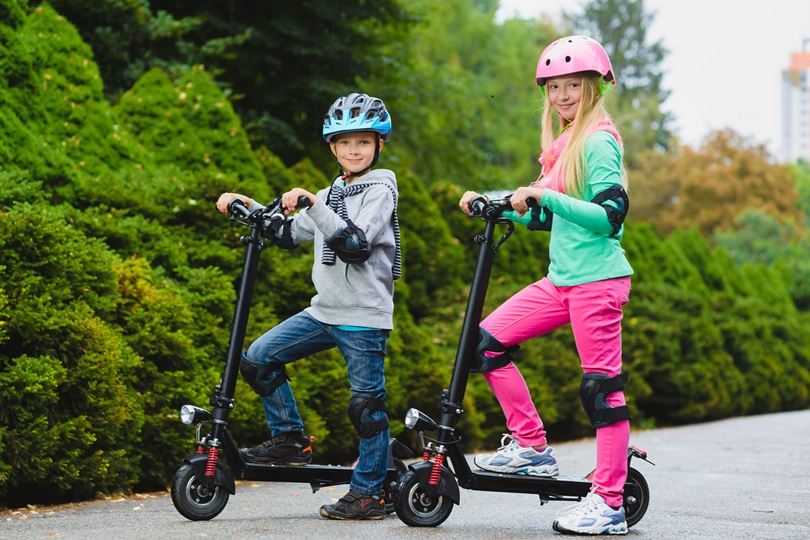
They’re fast, fun, growing increasingly in popularity and, if you have a kid or a tween begging for one, an electric scooter can look like the natural next step up from the kick scooter they’ve been riding around on since Kindergarten.
But an e-scooter is not merely a regular scooter with a motor attached. They are vehicles that can travel surprisingly fast, put riders into traffic alongside cars and bikes, and are sending a growing number of Canadian children to emergency departments with serious injuries.
In fact, in some Canadian cities, kids aren’t legally allowed to ride them at all. And you may be surprised to learn that in Toronto, nobody is allowed to ride an e-scooter on public streets, sidewalks, bike lanes, trails, paths, or even parks.
So if you’re wondering if e-scooters are safe or even legal for kids, the answer is no. So before one lands on your kid’s birthday wish list, here’s what parents need to know.
Canadian Kids Are Getting Hurt on E-Scooters
The numbers coming out of Toronto’s Hospital for Sick Children are concerning. SickKids reported 107 e-scooter injury cases in 2025, more than double the 46 cases recorded in 2024.
“E-scooters and other similar devices can be attractive to children who may view them as toys,” said Dr. Suzanne Beno, Medical Co-Director of the Trauma Program and Emergency Physician at SickKids.
But they’re not toys.
SickKids specifically identified high speeds, young rider age, interactions with motor vehicles and lack of helmet use as factors that put children and teens at risk of serious injuries from falls and collisions. Even more concerning, e-scooters accounted for 85 per cent of the battery-powered-device injuries recorded in the SickKids Trauma Registry from 2021 through 2024. In 56 per cent of the e-scooter injuries seen in its emergency department, the young rider wasn’t wearing a helmet.
E-Scooter Injuries Are Serious
We can easily picture the consequences of falling off a bicycle travelling at a decent speed. An e-scooter crash involves many of the same forces, without the rider even having to pedal to reach speed.
Canadian injury surveillance data gives us a clearer idea of what can happen.
A Public Health Agency of Canada study of motorized scooter injuries recorded 523 injuries at participating Canadian hospitals between 2012 and 2019.
More than one-third involved a fracture or dislocation, and 14.3 per cent of patients were admitted to hospital rather than simply treated and sent home.
Perhaps most relevant to parents is the largest group of injured riders was kids ages 10 to 14.
Falls accounted for more than half of the injuries, while almost three in 10 incidents occurred in traffic. Researchers also found a large proportion of injuries involving the head, forearm, and wrist.
Helmets Help but They Don’t Make an E-Scooter Safe
A properly fitted helmet is essential every time children are riding bicycles, scooters, skateboards or any other wheeled devices. And a helmet does not eliminate the risks associated with an electric scooter.
E-scooter riders must simultaneously control speed, balance, steer, watch for pedestrians, negotiate bike and vehicle traffic, and react to potholes, curbs, and other obstacles. That’s a lot to manage, particularly for younger riders whose judgement, coordination and ability to anticipate traffic hazards are still developing.
And even though a helmet can reduce the risk of a serious head injury, it can’t prevent broken wrists, arms, facial injuries, or collisions with vehicles.
And Please, No Doubling
It may look harmless to have a sibling or friend hop on for a quick ride, but e-scooters are designed for one rider and one rider only. An extra passenger changes the weight and balance of the scooter and makes steering and stopping more difficult. And it’s also explicitly prohibited in cities that do allow e-scooters. Vancouver permits only one rider per device, for example, and Calgary imposes a $75 fine for carrying a passenger on a shared e-scooter.
Check Your City’s Laws
This is where things get confusing for Canadian parents. The ability to buy an e-scooter doesn’t necessarily mean your child can legally ride it. The rules differ dramatically from city to city.
Toronto
E-scooters are currently illegal to operate on public property in Toronto. That includes streets, sidewalks, bicycle lanes, cycle tracks, trails, paths, and parks.
The City of Toronto points out an important distinction for parents because retailers are allowed to sell e-scooters even though riders can’t legally operate them in public spaces.
Ontario’s provincial e-scooter pilot prohibits riders 15 and younger, even in participating municipalities that permit e-scooters.
Read the City of Toronto’s e-scooter rules.
Ottawa
Ottawa allows e-scooters, but riders of personal e-scooters must be at least 16 years old. They aren’t permitted on sidewalks, and the maximum operating speed is 20 km/h.
Check Ottawa’s current e-scooter rules.
Vancouver
Vancouver requires personal e-scooter riders to be at least 16 and to wear a helmet. Riders can’t use sidewalks, carry passengers, or exceed 25 km/h.
See Vancouver’s e-scooter rules and safety information.
Calgary
Calgary’s rules distinguish between privately owned and approved shared e-scooters. Shared scooters are restricted to riders 18 and older, while privately owned e-scooters may only be used on the city’s pathway network and not on public roads or sidewalks, and they must follow the pathway speed limit of 20 km/h.
Read Calgary’s e-scooter regulations.
Wherever you live, check your municipality’s current regulations rather than assuming the rules you’ve seen elsewhere apply at home. And just because you see them everywhere, doesn’t mean they’re legal.
“But All Their Friends Have One”
This may be the hardest argument for parents to counter.
E-scooters are cool. They’re convenient. And when kids see friends zipping around on them, the risks can feel theoretical, especially if nobody they know has been injured.
But legality and safety rules aren’t put in place specifically to ruin their fun. The fact that major Canadian cities impose minimum ages, speed limits, helmet requirements, and restrictions on where e-scooters can be ridden should tell us something about the level of judgement and responsibility required to operate one.
There are plenty of ways for kids to have independence on wheels without adding a motor. Bicycles, traditional kick scooters, skateboards, and rollerblades all offer freedom, exercise and the ability to get around and effort required to propel them naturally limits speed to some extent.
The Bottom Line for Parents
E-scooters aren’t inherently bad. Where permitted and when ridden responsibly, for adults and older teens they can be a convenient form of transportation.
But they’re motorized vehicles, not children’s toys.
If your child is asking for one, don’t base the decision on the age recommendation printed on the box or the fact that they’re readily available for sale. Check your local laws first and pay attention to what Canadian children’s hospitals are seeing.
A disappointed kid is difficult but a preventable trip to the emergency department is considerably worse.